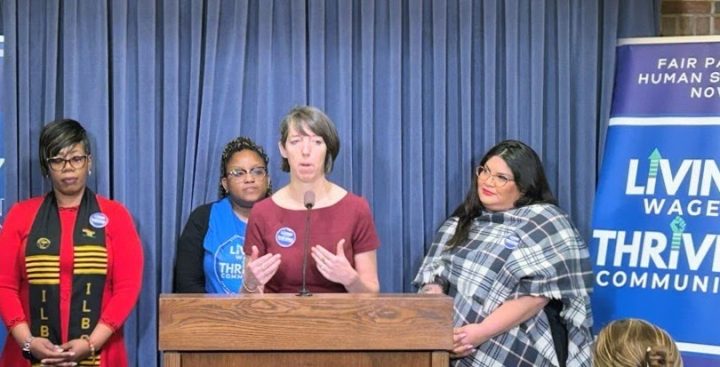
SPRINGFIELD, IL — February 26, 2026 —Illinois Partners for Human Service (IL Partners), a statewide coalition representing more than 850 community-based organizations and leader of the Living Wages, Thriving Communities Campaign, held a press conference yesterday morning in the Capitol Blue Room alongside leading state legislators and frontline human services leaders to advance two critical bills aimed at stabilizing and strengthening Illinois’ human services workforce.
Featured speakers included State Representative Yolanda Morris (D-9), State Senator Graciela Guzmán (D-20), and State Representative Lindsey LaPointe (D-19), along with human services leaders Sherrie Crabb, CEO/Executive Director of Arrowleaf, and Cristina Alexander, MA, LMFT, RDT of Family Focus.
In opening remarks, Adela Carlin, Senior Director of Advocacy for IL Partners, raised concerns about the Governor’s FY27 budget proposal.
“Essential workers have gone undervalued and underpaid for far too long,” said Carlin. “Flat and insufficient funding for core human services is effectively a cut when rising costs and inflation are taken into account. Our workforce — and the communities they serve — cannot afford continued underinvestment.”
Representative Yolanda Morris (D-9), Chief House Sponsor of the Human Service Workforce Sustainability Act (HB4450 / SB2883), spoke from her 26 years of experience as a certified nurse and union organizer.
“I’ve seen firsthand the challenges our human services workers face every day,” said Morris. “The lack of living wages is not just a workforce issue — it’s a crisis we can no longer ignore.”
Sherrie Crabb underscored the severity of the wage problem.
“Eighty-two percent of frontline human services workers do not earn a living wage — that’s not just a data point, it’s a red flag,” said Crabb. “We are not experiencing a workforce shortage. We are experiencing a wage shortage.”
Cristina Alexander, an experienced child and family therapist, spoke about the impact of the Human Service Professional Loan Repayment Program on her life and career.
“The children and families I serve look forward to seeing me as much as I look forward to seeing them,” Alexander said. “Loan repayment didn’t just forgive my debt — it changed the trajectory of my life. This program strengthens not only workers, but the families and communities we serve.”
State Senator Graciela Guzmán (D-20), Chief Senate Sponsor of the Human Service Workforce Sustainability Act, emphasized the broader impact of the legislation.
“I am able to serve as a legislator today because of the human services workers who supported me and my family,” said Guzmán. “This bill is about dignity. It is about infrastructure — not charity. It protects our existing programs and ties future increases to cost of living so we do not repeat the same mistakes year after year.”
Representative Lindsey LaPointe (D-19), Chair of the House Mental Health & Addiction Committee and Chief House Sponsor of the Human Service Professional Loan Repayment Program (HB4362 / SB2901), highlighted declining funding for the program.
“I’ve worked nights and weekends for low pay because I loved the people I served,” LaPointe, an admitted “social worker turned state legislator,” said. “But our professionals cannot continue to sacrifice while funding drops from $5 million to $1.25 million and now to $600,000. That just ain’t right!”
She added:
“Chronic underinvestment directly fuels recruitment and retention challenges. We are laser-focused on passing both the Workforce Sustainability Act and the Loan Repayment Act. Something has to change.”
When asked about the Governor’s position, LaPointe acknowledged progress while emphasizing the need for long-term solutions.
“This administration has made important strides rebuilding after years of instability,” she said. “But this isn’t just about securing more money. It’s about sustainable revenue and educating our colleagues about the long-term costs of underinvestment.”
Cosette Ayele, Director of Advocacy and Workforce Initiatives at IL Partners, closed the event by defining “living wages.”
“We rely on the MIT Living Wage Calculator as our benchmark,” Ayele said. “Workers must be able to meet their basic needs. While the statewide average salary for human services workers is about $47,000, in some regions, like Danville, it’s closer to $39,000. That gap underscores why legislative action is urgent.”
About Illinois Partners for Human Service
Illinois Partners for Human Service is a coalition of more than 850 organizations statewide engaged in policy, advocacy, and research to strengthen community-based human services.
About the Living Wages, Thriving Communities Campaign
The Living Wages, Thriving Communities Campaign unites more than 150 organizations, providers, frontline workers, and policy leaders representing the 350,000-plus human service workers across Illinois. Building on prior bipartisan resolutions, the campaign seeks fair, sustainable funding that allows essential workers to thrive in the communities they serve. Learn more at LivingWageIL.org.
# # # #